
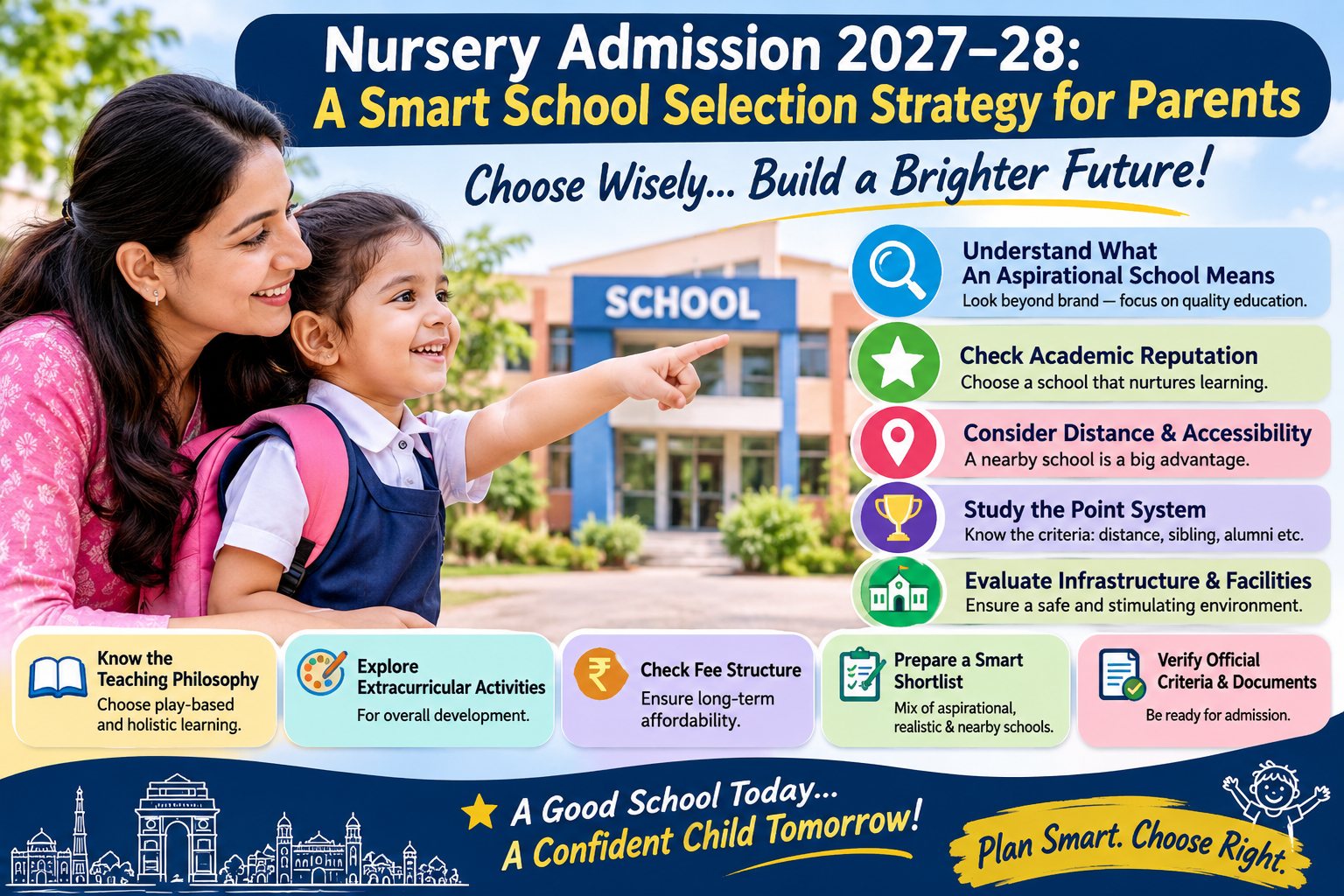
Nursery Admission 2027–28: A Smart School Selection Strategy for Parents
Choosing the Right Foundation for Your Child’s Future
Choosing a school for nursery admission is one of the most important decisions parents make in their child’s early years. For many families, nursery admission is not simply about securing a seat in a reputed institution; it is about finding a school that provides the right environment for learning, personality development, confidence and lifelong growth.
With several reputed schools offering nursery admissions in Delhi, parents often face a common dilemma: Should they apply only to highly reputed schools, choose a school close to home, or consider institutions where their child has a better chance of securing admission?
The answer lies in making a balanced and well-informed choice.
1. Understand What an Aspirational School Means
An aspirational school is an institution that parents genuinely wish their child to attend because of its academic reputation, educational philosophy, infrastructure, teaching standards, extracurricular activities and overall learning environment.
However, a school’s popularity or brand name should not be the only deciding factor. The right school should match the child’s developmental needs and the family’s expectations.
Parents should look beyond rankings and consider the quality of education and care offered during the foundational years.
2. Evaluate the School’s Academic Reputation
Before selecting a school, parents should research its academic track record and educational approach.
Important factors include:
- Quality and experience of teachers.
- Teaching methodology and curriculum.
- Emphasis on conceptual learning rather than rote memorisation.
- Language development and communication skills.
- Opportunities for creative and independent thinking.
- Continuity of education from nursery to senior secondary classes.
A good nursery school should focus on learning through play, exploration, interaction and practical experiences.
3. Give Importance to Distance and Accessibility
Distance is particularly important in Delhi nursery admissions because several private schools award significant admission points based on neighbourhood proximity.
For the 2027–28 admission cycle, some schools have allocated 50–70 points for residential proximity, while a few have given as many as 90 points.
For example, DPS RK Puram has allocated:
- Within 6 km: 50 points
- Above 6 km and up to 8 km: 40 points
- Above 8 km and up to 15 km: 30 points
- Beyond 15 km: 20 points
Parents should carefully check whether a school calculates distance by aerial measurement or road distance.
Apart from admission points, a shorter commute helps young children maintain a healthy routine, get sufficient sleep and spend more time with their families.
4. Study the Nursery Admission Point System
In Delhi, private unaided recognised schools generally follow a 100-point admission framework for open seats.
Each school publishes its own criteria and point allocation. Commonly considered categories include:
- Distance from school.
- Sibling studying in the same school.
- Parent alumni status.
- Other permitted school-specific criteria.
Parents should calculate their child’s expected score for every shortlisted school before submitting applications.
A school with a prestigious reputation may not necessarily be the most practical option if the child’s residential distance attracts fewer points.
It is important to remember that higher points improve the relative admission position but do not guarantee admission.
5. Assess Infrastructure and Learning Facilities
The physical environment plays an important role in early childhood education.
Parents should evaluate:
- Safe and hygienic classrooms.
- Age-appropriate furniture.
- Well-equipped activity and play areas.
- Outdoor sports facilities.
- Libraries and creative learning spaces.
- Clean drinking water and sanitation.
- CCTV, security and child supervision.
- Medical and emergency support.
The school should provide a safe, welcoming and stimulating environment where children feel comfortable exploring and learning.
6. Understand the School’s Teaching Philosophy
Nursery is the beginning of a child’s formal educational journey. At this stage, emotional security, curiosity and social interaction are as important as academic development.
Parents should understand whether the school promotes:
- Play-based learning.
- Experiential activities.
- Storytelling and creative expression.
- Music, dance and art.
- Physical development.
- Social skills and emotional intelligence.
- Positive reinforcement instead of excessive academic pressure.
The objective should be to develop confident, curious and happy learners.
7. Consider Extracurricular Activities
Aspirational schools should offer opportunities beyond classroom teaching.
Parents should explore the availability of:
- Sports and physical education.
- Music and dance.
- Art and craft.
- Theatre and storytelling.
- Yoga and mindfulness.
- Cultural celebrations.
- Group activities and collaborative learning.
These activities help children discover their interests and develop communication, creativity and teamwork.
8. Check Fee Structure and Financial Sustainability
School selection should also be based on the family’s long-term financial capacity.
Parents should enquire about:
- Admission and annual charges.
- Monthly or quarterly tuition fees.
- Transport charges.
- Books and stationery.
- Uniform expenses.
- Activity and other additional charges.
- Expected fee structure in higher classes.
A school should be financially sustainable for the family throughout the child’s educational journey.
9. Prepare a Smart School Shortlist
Instead of applying randomly, parents should divide their shortlisted schools into three categories.
Category A – Aspirational Schools
Highly preferred institutions with strong academic reputations, established infrastructure and the educational environment parents desire.
Category B – Realistic Schools
Schools that offer a good educational environment and where the child’s admission-point score appears reasonably competitive.
Category C – Practical or Nearby Schools
Good neighbourhood schools with manageable commuting distances, suitable fee structures and convenient accessibility.
This approach helps parents balance their aspirations with realistic admission possibilities.
10. Verify Official Admission Criteria and Documents
For Delhi Nursery Admission 2027–28, parents should carefully follow the Directorate of Education’s admission schedule and individual school notifications.
The important dates include:
- Registration begins: 1 December 2026.
- Last date for applications: 28 December 2026.
- Publication of applicant points: 4 January 2027.
- First selection list: 20 January 2027.
- Second selection list: 5 February 2027.
Parents should keep the following documents ready, subject to the individual school’s requirements:
- Birth certificate of the child.
- Residence proof.
- Passport-size photographs.
- Parent identity documents.
- Sibling proof, wherever applicable.
- Alumni certificates, wherever applicable.
Always verify the applicable requirements on the official school website and the Delhi Directorate of Education portal.
Conclusion: Choose a School That Builds a Better Future
Choosing an aspirational school should not be driven solely by reputation, competition or social expectations. The most suitable school is one that provides a nurturing environment, quality education, safety, individual attention and opportunities for holistic development.
Parents should adopt a strategic approach by comparing schools on academic quality, admission points, distance, infrastructure, teaching philosophy, extracurricular opportunities and affordability.
Ultimately, the purpose of nursery education is not just to prepare children for examinations but to develop happy, confident, independent and responsible individuals.
A good school gives a child an education; the right school gives a child the confidence, values and foundation to succeed in life.